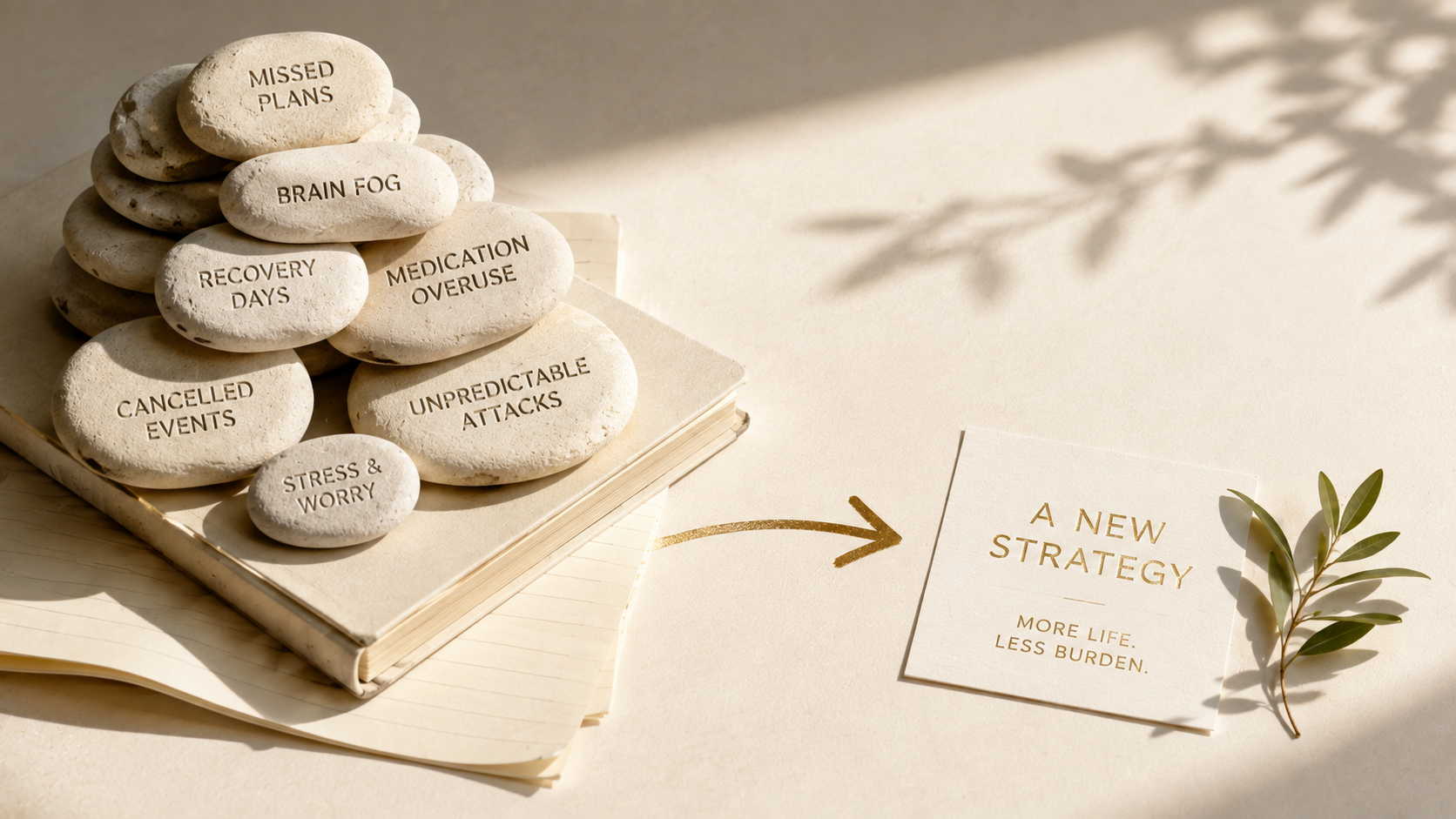
Migraine and sleep are closely connected, but the advice people receive about sleep can feel frustratingly simple.
“Get more sleep.”
“Go to bed earlier.”
“Stop looking at screens.”
“Keep a better routine.”
That advice may be well-intended, but if you live with migraine, you already know sleep is not always something you can control. Migraine can disrupt sleep. Poor sleep can make migraine harder to manage. Symptoms can wake you in the middle of the night. Brain fog can make routines harder to follow. Light sensitivity can make evenings feel overwhelming. Pain, nausea, stress, medications, hormonal shifts, and anxiety about the next attack can all interfere with rest.
So the goal is not perfect sleep.
The goal is a steadier rhythm.
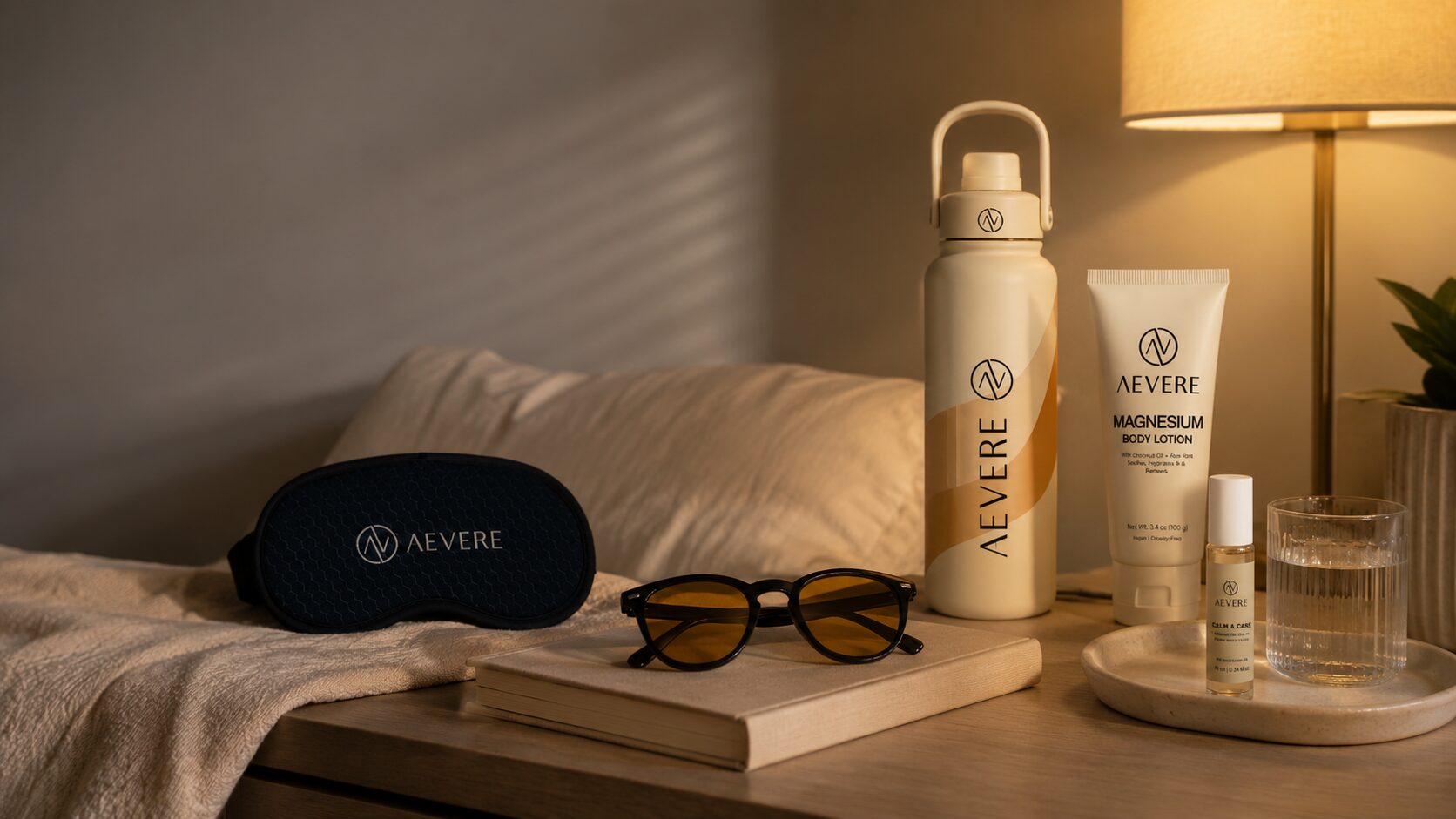
This article explores what actually matters when it comes to migraine and sleep — including consistency, light exposure, sensory load, rest routines, and how supportive tools like the Aevere Ritual System, FL-41 glasses, cooling eye mask, and hydration bottle can fit into a calming evening routine without making sleep feel like another thing to manage perfectly.
For more on daily rhythm and migraine support, read Migraine and Hydration: What Actually Matters and Food and Migraine: What the Science Actually Says.
Migraine and Sleep: Why This Connection Matters
Migraine and sleep have a two-way relationship. Poor sleep can make the brain more sensitive to migraine triggers, and migraine can make it harder to fall asleep, stay asleep, or wake feeling restored.
The American Migraine Foundation explains that sleep plays an important role in how the brain regulates pain, processes sensory information, and restores balance. When sleep is disrupted, the brain may become more sensitive to migraine triggers.
The Migraine Trust also describes migraine and sleep as closely linked and notes that improving sleep routine may be a helpful part of migraine self-management for some people.
That does not mean sleep is a migraine treatment. It does not mean poor sleep causes every attack. And it does not mean people with migraine are responsible for attacks because they did not sleep “correctly.”
It means sleep may be one part of the larger migraine threshold.
Migraine is often influenced by the combined load on the nervous system. Sleep disruption, skipped meals, dehydration, stress, sensory overload, hormonal changes, weather shifts, and irregular routines can all add strain. For some people, sleep consistency is one of the most meaningful pieces of that pattern.
Can Poor Sleep Trigger Migraine?
For some people, yes. Poor sleep may contribute to migraine patterns.
But the word “trigger” needs context. A trigger is not always a single cause. It may be one factor that lowers the threshold for an attack when other factors are already present.
For example, a night of poor sleep may matter more if you also skipped dinner, drank less water, had more stress, spent extra time under bright lights, or were already in the early stages of a migraine attack.
This is why migraine and sleep should be understood as a pattern, not a blame-based equation.
A more helpful question is not simply, “Did I sleep enough?”
A better question might be:
- Did I go to bed and wake up at very different times than usual?
- Did I sleep much less than normal?
- Did I sleep much more than normal?
- Did I wake up frequently during the night?
- Did pain, nausea, anxiety, or light sensitivity disrupt sleep?
- Did I use screens late into the evening?
- Did I skip meals, hydrate poorly, or have caffeine later than usual?
Those questions help turn sleep from a source of guilt into a useful pattern to observe.
Why Too Much Sleep Can Also Matter
Sleep deprivation is commonly discussed in migraine, but too much sleep can also matter for some people.
The American Migraine Foundation notes that both sleep loss and oversleeping can be common headache triggers. This may be one reason some people notice migraine attacks after sleeping in, napping unusually long, or changing their weekend schedule dramatically.
This does not mean naps are bad. It does not mean rest is wrong. People with migraine often need rest, especially during or after an attack.
The issue is usually not rest itself. The issue is sudden disruption to the body’s expected rhythm.
If your body is used to waking around the same time each day and then you sleep several hours later, that change may interact with other factors, such as caffeine timing, skipped breakfast, dehydration, blood sugar changes, or changes in medication timing.
The Aevere perspective is not “never sleep in.”
It is: pay attention to rhythm.
Sleep Consistency vs. Sleep Perfection
Many people with migraine already feel pressure to optimize everything. Sleep can become one more area where they feel like they are failing.
But perfect sleep is not realistic.
Children wake up. Work schedules change. Stress happens. Symptoms interrupt rest. Hormones shift. Travel disrupts routines. Migraine itself can make sleep unpredictable.
That is why consistency matters more than perfection.
A consistent routine does not mean every night looks identical. It means your body receives familiar cues often enough to understand when it is time to wind down, recover, and transition toward rest.
Those cues can be simple:
- dimming lights at the same time most nights
- keeping a water bottle on the nightstand
- switching to softer lighting in the evening
- putting FL-41 glasses nearby for screen-heavy nights
- using a cooling eye mask as part of a calming rest ritual
- reducing decision-making before bed
- tracking sleep patterns lightly without obsessing
The goal is not to perform sleep perfectly. The goal is to make rest easier to return to.
Waking Up With Migraine
Many people with migraine experience attacks that appear overnight or early in the morning. This can feel especially discouraging because it seems like the day starts before you ever had a chance.
Morning migraine may be connected to sleep disruption, inconsistent sleep-wake timing, dehydration, blood sugar changes, caffeine timing, medication wearing off, sleep apnea, stress, hormonal patterns, or other medical factors.
If you often wake up with migraine, it may be helpful to track:
- bedtime and wake time
- sleep quality
- whether you woke during the night
- evening screen use
- late caffeine or alcohol
- hydration before bed
- meal timing
- snoring, gasping, or possible sleep apnea symptoms
- stress level the day before
Repeated morning migraine is worth discussing with a healthcare provider, especially if it is new, worsening, or paired with sleep apnea symptoms such as loud snoring, gasping, daytime sleepiness, or waking unrefreshed.
Migraine, Brain Fog, and Sleep Disruption
Sleep disruption can make migraine brain fog feel even heavier.
Brain fog can show up as trouble finding words, difficulty focusing, slower processing, forgetfulness, mental fatigue, or a feeling that simple tasks take more effort than they should.
When poor sleep overlaps with migraine, the brain may have less capacity to handle light, noise, decisions, stress, work, conversations, and daily routines. This can make it harder to hydrate, eat consistently, take medications on schedule, track symptoms, or maintain an evening routine.
That is one reason migraine support tools should not require a lot of thinking.
A visible water bottle. Glasses placed by the laptop. A cooling eye mask on the nightstand. A simple ritual kit in one location. These small cues reduce the number of decisions you have to make when your brain is already tired.
For more on cognitive symptoms, read Migraine Brain Fog: Why Thinking Feels Harder.
Light, Screens, and the Evening Nervous System
Light sensitivity is one of the most common and disruptive migraine symptoms. For many people, bright lights, screens, overhead lighting, glare, or visual contrast can feel harder to tolerate, especially later in the day when the nervous system is already tired.
Evening light exposure can also interfere with the body’s natural sleep-wake cues. This does not mean screens are always avoidable. Many people work late, care for family, answer emails, manage schedules, or use their phone to unwind.
The goal is not to shame screen use. The goal is to make the evening environment gentler.
That might look like:
- dimming overhead lights
- switching to lamps or warmer lighting
- lowering screen brightness
- using night mode or warmer display settings
- taking visual breaks
- wearing FL-41 glasses when light feels uncomfortable
- keeping the bedroom darker and quieter when possible
Aevere’s FL-41 Solace Glasses and FL-41 Vantage Glasses are designed as sensory-aware support tools for people who are sensitive to harsh light, screens, and artificial lighting. They are not a migraine treatment or cure, but they can be part of a calmer light-management routine for people who find FL-41 lenses helpful.
How to Build a Migraine-Aware Sleep Routine
A migraine-aware sleep routine should be realistic, gentle, and repeatable.
It should not feel like a strict checklist you have to complete perfectly every night. It should feel like a set of cues that help your body shift toward rest.
Here is one example of a simple Aevere-style evening ritual:
- Start with light. Dim harsh lighting and switch to softer lamps when possible.
- Reduce visual strain. Use warmer screen settings or FL-41 glasses if screens or artificial light feel uncomfortable.
- Set hydration nearby. Place the Aevere hydration bottle on your nightstand so water is visible and easy to reach.
- Create a cooling cue. Place the Aevere Cooling Eye Mask near your bed or in a chilled-safe location according to product directions.
- Support body awareness. Use the Aevere Magnesium Body Lotion as part of a calming body-care ritual if it fits your routine and skin preferences.
- Keep the routine short. A five-minute ritual is better than a 30-minute routine you never use.
- Track lightly. Note sleep time, wake time, and migraine symptoms if patterns are unclear.
This is not about forcing sleep. It is about creating a lower-friction transition into rest.
What to Do When Migraine Disrupts Sleep
Sometimes migraine disrupts sleep no matter how consistent your routine is.
That does not mean the routine failed.
It means migraine is migraine.
When symptoms interrupt rest, the goal is to reduce friction and follow the care plan you have already established with your healthcare provider. That may include prescribed acute medication, hydration if tolerated, reducing light and sound, using a cool compress or eye mask, resting in a dark room, or asking for help when needed.
The Migraine Trust notes that resting somewhere dark and quiet can help people cope with light and noise sensitivity during an attack, and sleep may help some people after they have taken appropriate rescue medication.
For Aevere, this is where product organization matters. If your tools are scattered throughout the house, they are harder to use during symptoms. If your hydration bottle, FL-41 glasses, cooling eye mask, and other ritual tools live in a predictable place, you do not have to search for them when your brain is already overloaded.
How the Aevere Ritual System Supports Rest Routines
The Aevere Ritual System is not a sleep treatment and not a migraine treatment. It is a sensory-aware support system designed to make supportive routines easier to access, repeat, and adapt around real life.
For sleep and migraine, the system can support routines in a few practical ways:
- FL-41 glasses can support visual comfort during screen-heavy evenings or bright indoor lighting.
- The cooling eye mask can become part of a calming sensory ritual before bed or during rest periods.
- The hydration bottle keeps water visible and nearby so hydration does not depend entirely on memory.
- The magnesium body lotion can fit into a quiet body-care routine when you want a grounding, low-stimulation evening cue.
- The essential oil roller may be used as part of a personal calming ritual if scent is comfortable for you, though people with smell sensitivity should use caution and skip fragrance if it feels triggering.
The products do not replace medical care. They do not promise sleep. They do not prevent migraine attacks.
They help organize support around the moments when consistency is hardest.
Sleep Tracking Without Overwhelm
Sleep tracking can be useful, but it can also become stressful if it turns into another score to worry about.
If you are trying to understand migraine and sleep patterns, consider tracking lightly for a limited period. You might note:
- bedtime
- wake time
- estimated sleep quality
- night wakings
- screen use before bed
- late caffeine or alcohol
- hydration and meal timing
- morning migraine symptoms
- stress level the day before
You do not need to track everything forever. The goal is to notice whether repeat patterns show up often enough to be useful.
For a calmer approach to pattern awareness, read Migraine Tracking: How to Find Patterns Without Overwhelm.
When to Talk to a Healthcare Provider
Talk to a healthcare provider if sleep disruption is frequent, severe, worsening, or affecting your ability to function. You should also seek guidance if you often wake with migraine, if your headaches are new or different, or if you have symptoms that may suggest a sleep disorder.
Sleep apnea is especially important to discuss if you snore loudly, wake up gasping, feel excessively sleepy during the day, wake with morning headaches, or do not feel rested despite enough time in bed.
You should also talk to a provider if anxiety, depression, pain, medication side effects, hormonal changes, or other health conditions are affecting sleep. Migraine and sleep problems often overlap, and both deserve real support.
Sleep routines can support wellness, but they should not replace medical care or a migraine treatment plan.
The Aevere Perspective on Migraine and Sleep
At Aevere, we believe migraine and sleep should be discussed with compassion, not blame.
People with migraine are often told to live perfectly: sleep perfectly, hydrate perfectly, eat perfectly, avoid triggers perfectly, reduce stress perfectly, and track everything perfectly.
But migraine does not happen in a perfect life.
It happens in real life.
It happens with work deadlines, children waking up, bright lights, travel, stress, hormones, sensory overload, skipped meals, bad nights, early mornings, and days when even basic self-care feels harder than it should.
That is why Aevere focuses on supportive rituals instead of perfection.
A sleep routine does not have to be complicated to matter. A softer light. A bottle by the bed. Glasses near the screen. A cooling eye mask within reach. A short wind-down ritual. A predictable place for your support tools.
Small cues can create steadier rhythms.
And for people living with migraine, steadier rhythms can feel like relief from the constant pressure to figure everything out from scratch.
Final Thought
Migraine and sleep are connected, but the answer is not simply “sleep more.”
Sleep is part of a larger pattern. Too little sleep may matter. Too much sleep may matter. Irregular sleep may matter. Light, screens, hydration, meal timing, stress, sensory load, and migraine symptoms themselves may all affect how rest feels in the body.
The goal is not perfect sleep.
The goal is a steadier rhythm.
A softer evening. A more predictable routine. A lower-stimulation bedroom. A visible water bottle. FL-41 glasses nearby when light feels harsh. A cooling eye mask within reach when rest feels hard.
Sleep routines will not solve migraine.
But for some people, they can become one meaningful part of a calmer support system.
FAQ: Migraine and Sleep
Can poor sleep trigger migraine?
Poor sleep may trigger or worsen migraine attacks for some people. Sleep disruption can make the brain more sensitive to migraine triggers, but it should be understood as one possible factor in a larger pattern.
Can too much sleep trigger migraine?
For some people, yes. Oversleeping or sudden changes in sleep schedule may contribute to migraine patterns, especially when combined with changes in caffeine, hydration, meals, or wake time.
Why do I wake up with migraine?
Morning migraine may be related to sleep disruption, dehydration, caffeine timing, blood sugar changes, medication timing, stress, hormonal patterns, or sleep disorders such as sleep apnea. Frequent morning migraine should be discussed with a healthcare provider.
How can I build a migraine-aware sleep routine?
Start with simple, repeatable cues. Dim lights, reduce screen brightness, keep water nearby, use FL-41 glasses if light feels harsh, place a cooling eye mask near the bed, and keep the routine short enough to use consistently.
Do screens affect migraine and sleep?
Screens can be difficult for some people with migraine, especially if they are sensitive to light, glare, contrast, or evening stimulation. Lowering brightness, using warmer screen settings, taking breaks, and using FL-41 glasses may support visual comfort.
Can FL-41 glasses help with migraine and sleep?
FL-41 glasses are not a sleep treatment or migraine treatment, but they may support visual comfort for people who are sensitive to certain light conditions. They can be part of an evening light-management routine if screens or artificial lighting feel uncomfortable.
Can a cooling eye mask help with sleep?
A cooling eye mask is not a treatment for migraine or insomnia, but it can be part of a calming rest ritual. Some people find cool, dark, low-stimulation environments more comfortable during migraine symptoms or evening wind-down routines.
Should I track sleep if I have migraine?
Sleep tracking can be useful for a short period if you are trying to identify patterns. Track lightly and avoid turning it into another source of stress. Bedtime, wake time, sleep quality, night wakings, and morning migraine symptoms may be useful to note.
When should I talk to a doctor about migraine and sleep?
Talk to a healthcare provider if sleep disruption is frequent, severe, worsening, or paired with morning headaches, loud snoring, gasping, excessive daytime sleepiness, or headaches that are new or different from your usual migraine pattern.
How does the Aevere Ritual System support sleep routines?
The Aevere Ritual System helps organize sensory-aware support tools around daily routines. It is not a treatment or cure, but it can make evening support easier to access through tools like FL-41 glasses, a cooling eye mask, hydration bottle, and other calming ritual cues.