
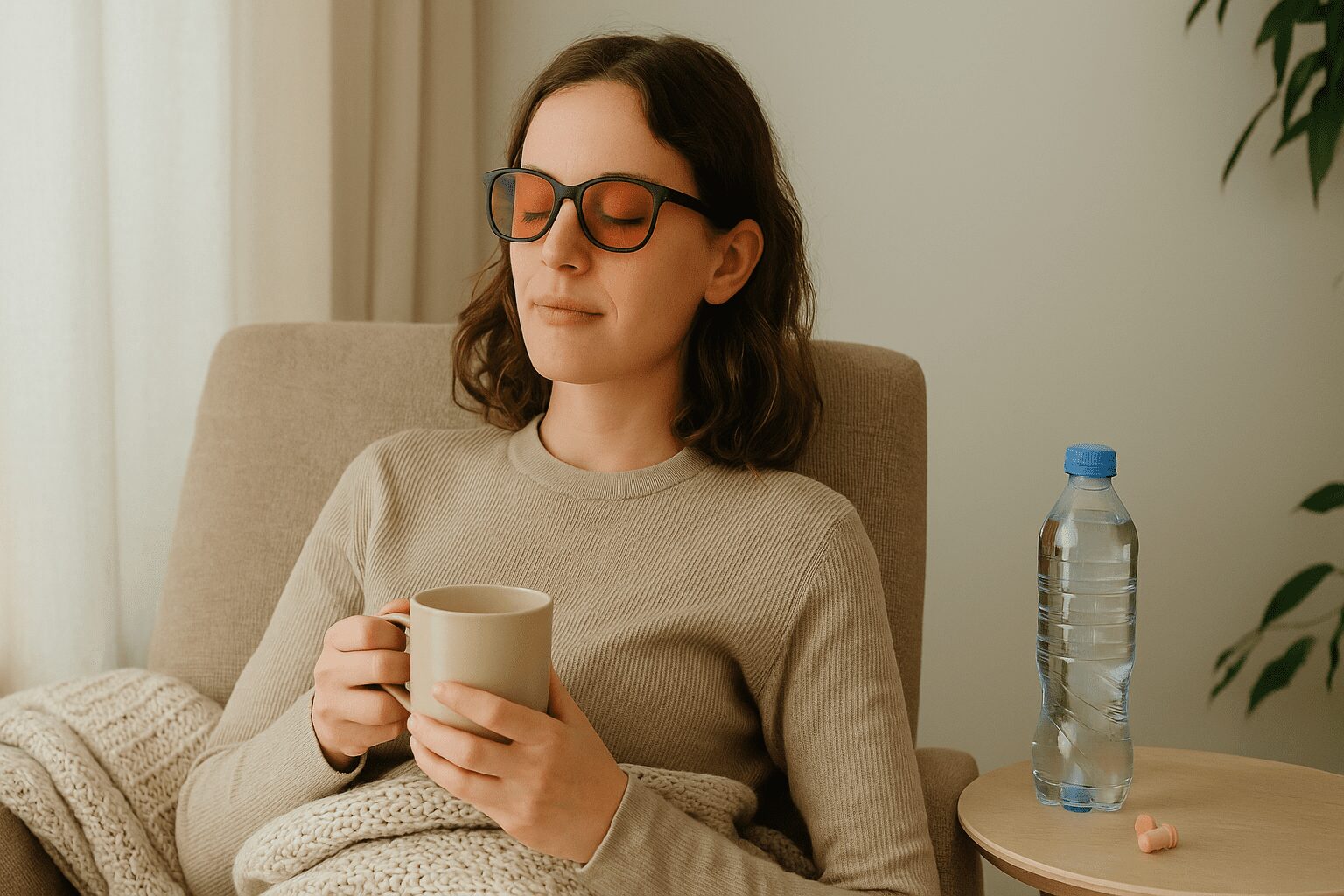
You walk into a busy supermarket. Fluorescent lights. Beeping scanners. Strong cleaning smells. Within minutes your shoulders tense, your thoughts scatter, and you just want out. Is that sensory overload, the start of a migraine, or both?
For people who live with migraine, this question isn’t academic—it determines your next move. The tricky part: migraine is a condition of a hypersensitive nervous system, which means sensory processing is front-and-center. Understanding where sensory overload ends and migraine begins helps you act quickly, reduce suffering, and prevent the spiral.
Quick answer
- Sensory overload = Your brain is getting more input than it can process right now. Relief often comes quickly once you reduce the input.
- Migraine = A multi-stage neurological event. Sensory overload can trigger it, and once it starts, ordinary light, sound, and smell can feel unbearable.
If you can leave the environment and feel better within minutes, it was likely overload. If symptoms persist, escalate to throbbing pain, nausea, or aura, you’re likely in a migraine episode.
What is sensory overload?
Sensory overload happens when input from one or more senses—sight, sound, smell, touch, taste—exceeds your system’s capacity to process it comfortably.
Common signs:
- Feeling irritable, anxious, or “on edge”
- Brain feels scattered; hard to focus or make decisions
- Urge to escape the space; relief when you do
- Body tension, shallow breathing, fatigue
It can happen to anyone, but it’s especially common in people with migraine, ADHD, autism, concussion history, vestibular conditions, or chronic stress.
What is migraine?
Migraine is a neurological disorder with phases that can span hours to days. It’s more than “just a headache.”
Typical features:
- Head pain: throbbing or pulsing, often one-sided
- Nausea/vomiting; food and smells feel repulsive
- Sensory hypersensitivity: light (photophobia), sound (phonophobia), smell (osmophobia)
- Aura (in ~1/3 of people): visual zigzags, blind spots; or sensory/language changes
- Postdrome (“migraine hangover”): fatigue, brain fog, mood changes after pain eases
The overlap: why they feed each other
- Sensory overload can trigger migraine. In a primed system, too much light/sound/smell can kick off the migraine cascade.
- Migraine amplifies overload. During an attack, ordinary sensations feel extreme. You’re not “dramatic”—your brain’s filters are dialed down.
This creates the storm loop: overload → migraine → more overload. Your job is to break the loop early.
A quick self-check you can do anywhere
Ask yourself three questions:
- Relief test: If you step into a dark, quiet space for 5–10 minutes, do symptoms settle?
- Yes, mostly: likely sensory overload.
- No, or they escalate: likely migraine starting.
- Specific vs global:
- Overload often feels global—everything is “too much.”
- Migraine may spotlight one sense (eg, light feels like knives) and adds migraine-typical symptoms (nausea, throbbing, aura).
- Migraine markers present?
One-sided throbbing, nausea, aura, or a familiar prodrome feeling (yawning, neck stiffness, food cravings) points to migraine.
What to do in the moment (choose A or B)
A) If it seems like sensory overload
- Exit or reduce stimuli fast. Step outside; dim lights; turn off music; use sunglasses/FL-41 glasses; put in earplugs.
- 90-second reset. Slow nasal inhale to a count of 4, exhale to 6, repeat for 90 seconds.
- Ground your senses. Identify 3 things you see, 2 you feel, 1 you hear. Sip water.
- Re-enter with boundaries. Shorten the errand, wear your tools (glasses, earplugs), avoid strongest triggers (cleaner aisle, bright end-caps).
B) If it feels like migraine is starting
- Treat early. Follow your clinician’s plan for acute meds at first sign.
- Go dark and quiet. Eye mask, earplugs, cool compress to forehead/neck.
- Hydrate + electrolytes. Small sips; consider ginger if nauseated.
- Calm the system. Gentle breathing or guided audio; minimal screen exposure.
Build your sensory-safe toolkit (home, work, out-and-about)
Light
- Choose warm, non-flicker bulbs; use lamps over overheads.
- Keep FL-41 light-filtering glasses in your bag and at your desk.
- Dim screens; enable dark mode; enlarge fonts.
Sound
- Carry soft foam earplugs or noise-reducing earbuds.
- Use white noise at home to mask intermittent sounds.
- Ask for quiet seating at restaurants; avoid peak hours when possible.
Smell
- Avoid aisles or spaces with strong cleaners or perfumes.
- Mask with a gentle essential oil you tolerate (eg, lavender or peppermint), dabbed sparingly.
- Choose fragrance-free detergents and lotions at home.
Touch/Temperature
- Cold pack for forehead/neck; heat for shoulder/neck tension.
- Soft fabrics; remove scratchy tags; layer for temperature control.
Physiology
- Water bottle + electrolyte sachets; sip steadily.
- Regular meals/snacks with protein and fiber; avoid long gaps.
- Short stretch breaks; posture checks to reduce neck strain.
Pro tip: Pack a small “sensory go-bag”—FL-41 glasses, earplugs, eye mask, cold pack, electrolyte packet, essential-oil roller, ginger chews.
“Sensory budget”: pace your day like your energy
Think of sensory input like a budget. High-input events (school pickup line chaos, big-box stores, concerts) “spend” your budget faster. Balance your day with low-input blocks to recover—dim light, quiet breaks, gentle movement.
- Stack fewer high-input tasks back-to-back.
- Add buffers: 5–10 minutes of dark/quiet time between errands or meetings.
- On sensitive days (poor sleep, approaching weather shift), lower the budget.
Avoid the over-avoidance trap
Reducing triggers helps, but complete avoidance can increase sensitivity over time. Aim for graded exposure: brief, controlled doses of manageable input while supported (glasses, earplugs), then back off. Over weeks, your nervous system often tolerates more without spiking.
Special cases worth knowing
- Aura without headache: Visual zigzags, blind spots, tingling, or speech glitches can occur with or without pain. Treat it like migraine—lower input, hydrate, rest, follow your plan.
- Vestibular migraine: Dizziness, motion sensitivity, balance issues. Minimize visual motion (busy patterns, fast scrolling), sit near walls, and use vestibular-friendly breathing and gaze stabilization drills if prescribed.
- Osmophobia (smell sensitivity): Carry a tolerable scent to mask unexpected odors. Request fragrance-free policies where possible.
For parents and partners
- Create a family signal for “sensory time-out.”
- Keep a quiet corner at home—soft light, eye mask, cold pack.
- Normalize accommodations: dimmed lights, lowered TV volume, fragrance-free products.
- For kids and teens: teach simple grounding (5-4-3-2-1), pack ear defenders, and coordinate with teachers for a low-stim space pass.
Track patterns and lower your trigger stack
Most migraines aren’t “one cause”—they’re stacked triggers. Sleep shift + skipped lunch + bright store can be the perfect storm. Tracking helps you see the stack so you can intervene earlier.
Inside the Aevere approach:
- Tag your inputs: light, sound, smell, screen time, crowds.
- Log sleep, hydration, meals, stress and any aura or prodrome clues.
- Review weekly to spot patterns and plan buffers before high-risk windows.
Want a head start? Download our free Sensory Profile Builder to map your personal sensitivities and pick the right tools for each sense. Join free today to access our free downloadable content: https://aevere.com/register/#signup-form
When to talk to your clinician
- New or changing aura symptoms
- Neurologic red flags: weakness, fainting, confusion, severe “worst headache”
- Migraine frequency increasing or attacks lasting longer
- You’re avoiding daily life because of sensory fears
Bring your log—it turns a vague story into clear data your clinician can act on.
A gentle, actionable plan you can start today
- Prepare your go-bag (glasses, earplugs, eye mask, cold/heat, electrolytes, ginger, essential-oil roller).
- Audit two spaces you use most (desk, bedroom). Fix the lighting, reduce glare, add quiet.
- Choose two buffers you’ll actually do (5-minute dark break after errands; breathing before meetings).
- Track for 7 days. Tag sensory inputs and symptoms to spot stacks.
- Reduce one stack. For example, on low-sleep days: earlier lunch, less screen brightness, a shorter store visit with glasses and earplugs.
Small moves, consistently, change the baseline.
Ready to understand your sensory profile—and get ahead of triggers?
Build your personalized plan with Aevere.
- Download the Sensory Profile Builder and map your light, sound, smell, and motion sensitivities.
- Get early access to our tools, guides, and calming audio designed for sensory-safe support.
Join free: https://aevere.com/register/#signup-form
FAQ
What’s the fastest way to tell sensory overload from migraine?
Step into a dark, quiet space for 5–10 minutes. If you improve quickly, it’s likely overload. If symptoms persist or escalate to throbbing pain, nausea, or aura, you’re likely in a migraine phase.
Can sensory overload trigger a migraine?
Yes. In migraine-prone brains, high sensory input can start the cascade that leads to an attack.
Why does normal light feel unbearable during migraine?
During migraine, your brain’s sensory filters are reduced. Ordinary input is amplified and can feel painful—especially certain wavelengths of light.
What tools help most in public places?
FL-41 light-filtering glasses, soft foam earplugs, a pocket eye mask, and a small cold pack. Add electrolytes and a gentle essential-oil roller you tolerate.
Is avoiding all triggers the best plan?
Short-term reduction helps, but full avoidance can increase sensitivity. Graded, supported exposure often builds resilience.
Wellness disclaimer: The information in this article is for general wellness and educational purposes and isn’t medical advice. Aevere does not diagnose, treat, cure, or prevent disease. Always consult your clinician for personal medical guidance.