
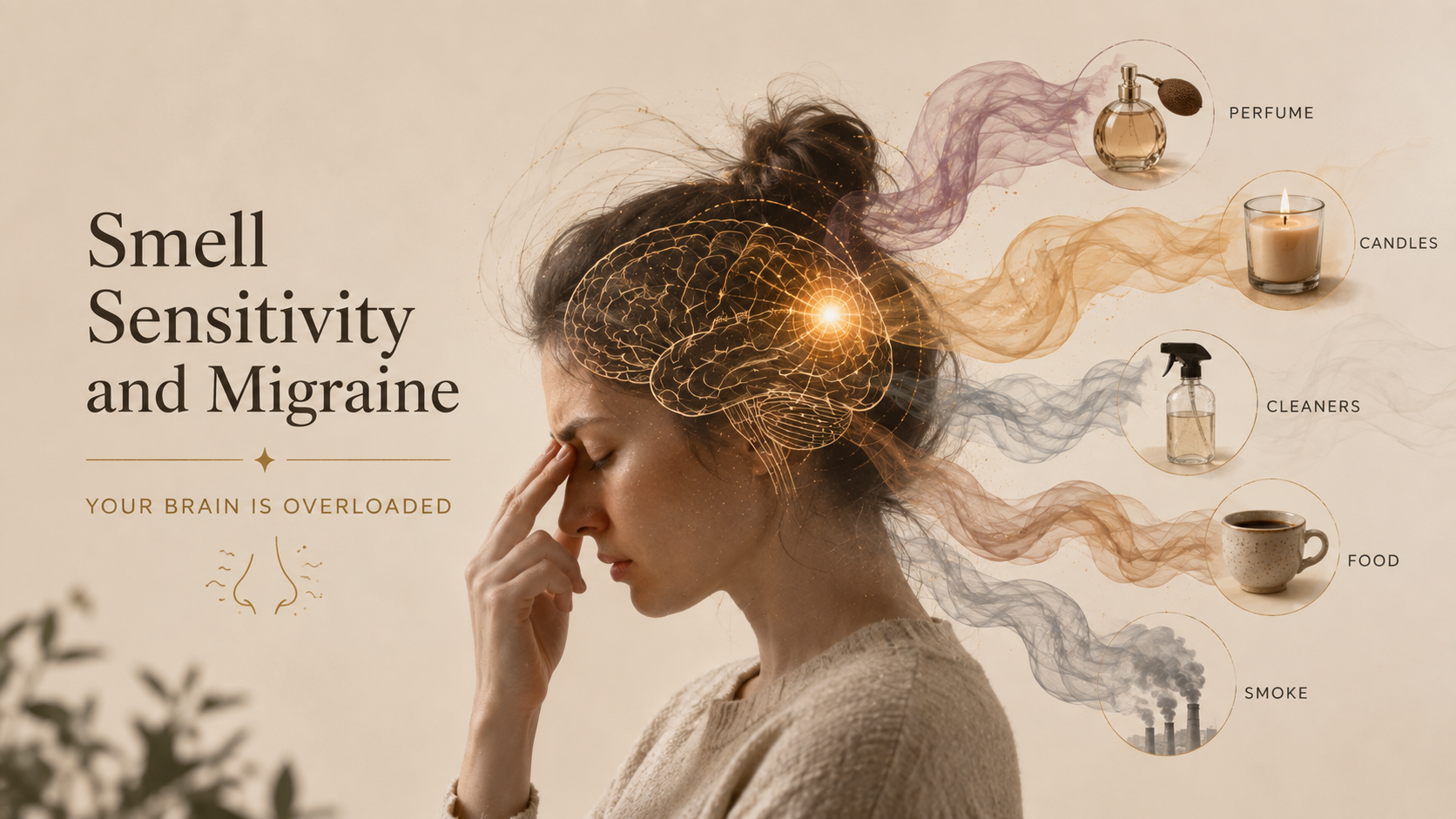
Smell sensitivity and migraine can turn an ordinary environment into something your nervous system experiences very differently from everyone around you. When a scent is present, it can intensify discomfort, blur focus, and increase sensitivity to sound and light. This variation is unique to each person.
A coworker walks in wearing perfume. Someone lights a candle across the room. Cleaning products are used in a nearby office. Food begins frying in a restaurant kitchen. Gasoline drifts through the air at a fuel pump. A scented laundry product lingers on someone’s clothing.
Other people may barely notice.
For you, the smell may suddenly feel impossible to ignore. Nausea rises. Pressure starts behind your eyes. Your thinking slows. Light becomes sharper. You may feel dizzy, irritated, trapped, or desperate to get away from a scent everyone else seems perfectly able to tolerate.
Then comes the part that can be almost as frustrating as the symptom itself.
“It isn’t that strong.”
“You’re being dramatic.”
“It’s only perfume.”
“You can’t possibly smell that from here.”
But smell sensitivity and migraine are not simply about liking or disliking fragrance. For many people with migraine, heightened sensitivity to odors—often called osmophobia—is part of a much larger neurological and sensory pattern.
The American Migraine Foundation identifies osmophobia, or sensitivity to strong smells, as a common migraine symptom and notes that perfume, pungent foods, gasoline, and chemical odors may trigger an attack or worsen one already underway.
At the 2026 Migraine World Summit, Gudrun Gossrau, MD, explored this connection in Scents, Chemicals & the Migraine Brain. Dr. Gossrau is a professor of neurology and headache and pain specialist at Technische Universität Dresden, where she directs the Headache Center and serves as vice head of the Interdisciplinary University Pain Center. Her Summit session examines scents, chemicals, volatile organic compounds, and how the migraine brain responds to environmental exposure.
The important question is not simply, “Do smells trigger migraine?”
Sometimes they may. But sometimes the relationship runs in the other direction: the migraine process may already be underway, and that changing nervous system may be the reason an ordinary scent suddenly feels unbearable.
Understanding that difference can change how you respond to the symptom—and how much blame you place on yourself.
Smell Sensitivity and Migraine Are More Than a Dislike of Fragrance
Everyone has smells they dislike. One person hates patchouli. Another cannot tolerate cigarette smoke. Someone else finds the smell of bleach unpleasant.
Osmophobia goes beyond preference.
It can involve an unusually strong aversion or physical sensitivity to odors, particularly around migraine attacks. A scent may feel amplified, invasive, nauseating, painful, or neurologically overwhelming. Instead of simply thinking, I don’t like that smell, your entire system may begin responding to it.
That response can include nausea, head pain, dizziness, difficulty concentrating, fatigue, irritability, light sensitivity, sound sensitivity, or an urgent need to leave the environment.
This fits into a much broader feature of migraine: sensory processing can change. Aevere’s guide to migraine sensory sensitivity explains why ordinary levels of light, sound, smell, movement, and environmental stimulation may become difficult for a migraine-sensitive nervous system to filter.
Smell is simply one part of that sensory picture.
A 2025 review of olfactory abnormalities in migraine describes several smell-related changes in people with migraine, including osmophobia and increased or otherwise altered odor perception. The research suggests that smell processing in migraine is more complex than a simple dislike of strong fragrances. Read the review on PubMed.
That distinction matters because the scent does not need to seem objectively strong to everyone else for your reaction to be real.
A migraine-sensitive brain may simply be processing the environment differently in that moment.
What Is Osmophobia in Migraine?
Osmophobia is the term commonly used to describe an aversion or heightened sensitivity to odors.
Although it is not one of the most widely recognized migraine symptoms outside headache medicine, research has repeatedly found it in people with migraine. One recent clinical study reported osmophobia in 68% of its migraine group, with perfume being the most commonly reported bothersome odor. Other studies have reported different prevalence rates depending on how osmophobia was defined and when patients were asked about it.
Research led by Dr. Gossrau has also examined interictal osmophobia—smell sensitivity that continues between migraine attacks rather than appearing only during one. Her study found that interictal osmophobia was associated with a greater migraine burden, including longer migraine history and other features of disease severity. Read the study here.
This helps explain an experience many people struggle to put into words. Some people are not only sensitive to fragrance once the headache starts. They may notice scents earlier than everyone else, remain wary of certain environments between attacks, or feel as though their sensory system never completely returns to baseline.
For someone living with that pattern, learning the word osmophobia can be surprisingly validating.
It gives language to something they may have spent years trying to explain.
Can Smells Trigger Migraine or Is Smell Sensitivity an Early Symptom?
This is one of the most important questions in the entire conversation about smell sensitivity and migraine.
Did the perfume cause the attack?
Or did the attack make the perfume suddenly unbearable?
Both possibilities deserve consideration.
The American Migraine Foundation notes that some odors may activate nerve receptors and may trigger a migraine attack. They may also worsen an existing attack. Perfume, strong food smells, gasoline, and chemicals are among the odors frequently reported by people with migraine. Read AMF’s overview of common migraine triggers.
But there is another side to the story.
The Migraine Trust points out that people often become more sensitive to light, noise, and odors during a migraine attack. Because this sensory change can happen early, it may be difficult to tell whether an environmental exposure triggered the migraine or whether the migraine had already begun and made the exposure suddenly intolerable.
That is the same confusion Aevere explores in Migraine Triggers vs. Early Symptoms.
Imagine walking into an office and immediately feeling overwhelmed by someone’s perfume. Thirty minutes later, nausea starts. Then light sensitivity. Then the familiar pressure behind your eye.
It would be perfectly reasonable to think:
That perfume caused my migraine.
And perhaps it contributed.
But what if the migraine process had already begun before you walked into the room? What if your changing sensory threshold was the reason the perfume suddenly felt ten times stronger?
That possibility does not mean fragrance exposures are irrelevant. It means the relationship may be more complicated than a simple trigger-and-effect equation.
Sometimes smell may contribute to the sensory load.
Sometimes heightened smell sensitivity may be an early warning sign.
Sometimes both may be true at the same time.
Why Smell Sensitivity and Migraine Can Feel So Intense
Smell is deeply connected to the brain.
Airborne odor molecules are detected by sensory receptors in the nose, which send information through neural pathways that allow the brain to identify and respond to odors. Smell also interacts closely with systems involved in memory, emotion, appetite, nausea, threat detection, and environmental awareness.
Researchers studying migraine have proposed that altered olfactory processing may involve interactions among the olfactory system, trigeminal pathways, autonomic systems, and broader migraine-related neural networks. A 2025 review of olfactory abnormalities in migraine summarizes evidence of structural, functional, and sensory differences related to smell processing in people with migraine. Read the full review.
For the person living through it, however, the science often feels much simpler.
A fragrance does not arrive alone.
It arrives on top of everything else.
The fluorescent lights are already too bright. The room is noisy. You did not sleep well. You skipped lunch. Your neck is getting tight. Your brain feels slightly foggy. Someone walks past wearing strong cologne.
Suddenly, that smell feels like the thing that broke the system.
This is why Aevere thinks about migraine through the lens of total sensory load, not just isolated triggers. Our article on migraine dizziness and vertigo explores the same phenomenon with visual motion, balance, and environmental overload.
A candle might feel perfectly tolerable on one day and impossible on another because your nervous system does not begin every day with the same amount of available capacity.
That is not inconsistency.
That is biology meeting environment.
7 Signs Smell Sensitivity and Migraine May Be Connected
These seven patterns cannot diagnose migraine or tell you with certainty whether an odor caused an attack. They can, however, help you recognize whether smell sensitivity may be part of your broader migraine pattern and give you better information to discuss with a healthcare professional.
1. Ordinary Smells Suddenly Become Unbearably Strong
One of the clearest signs that smell sensitivity and migraine may be connected is when familiar scents suddenly feel much more intense.
The laundry detergent has not changed. The coffee is the same. Your coworker wears the same perfume every day. Yet suddenly the scent feels impossible to ignore.
This may happen during an attack or as the attack is developing.
If heightened smell sensitivity appears alongside fatigue, yawning, irritability, neck stiffness, nausea, food cravings, light sensitivity, or brain fog, it may be worth considering whether the sensory change is part of migraine prodrome rather than an isolated reaction.
The American Migraine Foundation’s guide to migraine prodrome describes prodrome as the earliest phase of an attack and notes that sensory and cognitive changes can appear before the headache phase.
Aevere’s article on migraine symptoms beyond head pain also explores why these early neurological changes are often missed.
2. Smells Make Nausea, Head Pain, or Dizziness Worse
For some people, perfume, smoke, gasoline, cooking odors, candles, or cleaning chemicals do not simply smell unpleasant—they make existing migraine symptoms noticeably worse.
The American Migraine Foundation specifically notes that strong smells can trigger or worsen attacks in people with migraine.
You may begin with mild pressure behind one eye and suddenly feel nauseated after entering a scented room. Or you may already feel slightly dizzy and find that a strong fragrance pushes your sensory system into overload.
This can be particularly difficult for people who also experience vestibular symptoms. If dizziness, motion sensitivity, or feeling off-balance are part of your attacks, read Migraine Dizziness and Vertigo 7 Signs People Miss for a deeper look at how migraine can affect balance and spatial processing.
The important point is that smell may not be operating in isolation. It may be adding another layer of sensory stress to a nervous system that is already vulnerable.
3. Smell Sensitivity Appears With Light and Sound Sensitivity
Migraine often affects more than one sensory channel at once.
The fragrance feels stronger.
The lights feel brighter.
The conversation across the room feels louder.
The movement around you feels harder to process.
Research has found osmophobia to occur alongside other migraine-associated symptoms, including photophobia, phonophobia, nausea, and other sensory disturbances.
This matters because one isolated sensory complaint may be difficult to interpret. When smell sensitivity appears alongside several familiar migraine symptoms, the overall pattern becomes more informative.
Aevere’s Migraine Sensory Sensitivity guide goes deeper into why migraine can make the brain less effective at filtering ordinary environmental input.
The person is not necessarily encountering an extreme environment.
Their nervous system may simply be experiencing that environment more intensely.
4. You Notice Scents Long Before Everyone Else
Another pattern some people describe is becoming extraordinarily aware of smells.
You notice the cleaning spray from another room.
You smell cigarette smoke before anyone else.
You know someone has applied perfume before they walk through the door.
When other people say they cannot smell anything, it can be easy to feel dismissed or even question your own perception.
But altered odor sensitivity has been documented in migraine research. Recent reviews describe hyperosmia, osmophobia, and other changes in olfactory perception among people with migraine.
The fact that someone standing beside you cannot smell the fragrance as strongly does not mean your sensory experience is imaginary.
You may simply be processing it differently.
5. Scented Environments Begin Changing Where You Go
When smell sensitivity and migraine become severe, the problem can extend far beyond discomfort.
Perfume counters become risky.
Candle stores are off limits.
Salon appointments become difficult.
Hotel rooms feel unpredictable.
Rideshare vehicles may contain heavy air fresheners.
Restaurants combine food odors, cleaning products, perfume, heat, and noise.
Even someone’s home can become challenging because of laundry products, plug-in fragrances, candles, diffusers, or cleaning sprays.
The Migraine Trust has documented lived experiences of people with osmophobia avoiding restaurants, social occasions, and other environments because scent exposure could significantly worsen migraine symptoms. Read Sandip’s story about migraine and osmophobia.
That is not simply being “picky about smells.”
It can affect social connection, work, travel, family events, independence, and quality of life.
The more unpredictable the environment becomes, the more mental energy it can take simply to decide whether going somewhere is worth the risk.
6. The Same Types of Odors Keep Appearing Around Attacks
Patterns are more useful than isolated incidents.
If perfume, smoke, cleaning products, gasoline, candles, scented laundry products, or certain food odors repeatedly appear around your migraine attacks, documenting that pattern may be worthwhile.
Studies examining osmophobia frequently identify perfume among the most commonly reported problematic odors.
But tracking should go deeper than writing PERFUME = TRIGGER in a diary.
Ask:
Was I already tired?
Was my neck stiff?
Was I unusually sensitive to light that morning?
Did I notice the smell before nausea started or after?
Would that same perfume bother me on a low-symptom day?
Did leaving the environment stop the progression, or did the migraine continue anyway?
Those questions help separate correlation from pattern.
This is why Aevere advocates moving beyond a trigger-only mindset. In Stop Tracking Triggers. Start Building Protectors., we explore how tracking can identify both vulnerability and support instead of turning daily life into an endless list of things to fear.
7. Smell Sensitivity Continues Between Migraine Attacks
Not everyone returns to completely normal smell sensitivity between attacks.
Some people experience interictal osmophobia, meaning heightened odor sensitivity persists even when they are not in the obvious headache phase. Research led by Dr. Gossrau found interictal osmophobia in people with migraine and associated it with aspects of greater migraine burden.
This can create a strange feeling of never being completely “off duty.”
Even on a relatively good day, a strong fragrance can create discomfort or immediate concern that another attack is beginning.
That can lead to increased vigilance around environments, products, restaurants, coworkers, travel, and social situations.
Persistent smell changes deserve discussion with a healthcare professional, particularly when they are new, worsening, dramatically different from your normal sensory experience, or interfering with daily life.
Smell Sensitivity and Migraine at Work
The workplace is one of the hardest environments to control.
A coworker’s perfume may be completely normal within workplace culture but deeply disruptive to someone with migraine. The same can be true of fragranced lotion, hand sanitizer, cleaning products, air fresheners, industrial chemicals, break-room food, paint, or recently installed flooring or furniture.
The person living with migraine may then face an uncomfortable choice.
Say something and risk sounding demanding.
Or stay quiet and try to work while nauseated, foggy, dizzy, or fighting an escalating attack.
Neither is a good solution.
The Migraine Trust’s workplace guidance recommends discussing migraine with employers when appropriate and considering practical workplace adjustments based on individual needs.
Depending on the workplace, possible strategies might include fragrance-aware practices, lower-fragrance cleaning products, advance notice before painting or chemical work, ventilation changes, temporary relocation, remote-work flexibility, or access to a lower-sensory workspace.
The goal should not be to demonize people who enjoy fragrance.
The goal should be to recognize that a shared environment can affect different nervous systems in dramatically different ways.
This is part of the larger conversation Aevere is trying to advance: migraine-friendly environments should account for sensory accessibility, not just pain.
Why “Natural” Does Not Automatically Mean Migraine-Friendly
There is another misconception worth addressing because it appears frequently in wellness culture: synthetic fragrance is bad, while natural scent is automatically safe.
Migraine does not always respect that distinction.
Essential oils, flowers, eucalyptus, citrus, peppermint, herbs, incense, and other naturally derived scents can still feel overwhelming to a migraine-sensitive nervous system. Whether a scent is botanical or synthetic does not determine how every individual brain will respond to it.
That matters for Aevere as well.
Our approach to migraine support should never assume that one sensory experience works for everyone. A scented roller may feel soothing to one person and completely wrong for another. Someone may love peppermint while another person cannot tolerate it during an attack.
Choice matters.
This is the same philosophy behind the broader migraine lifestyle framework we explore in Migraine Lifestyle Changes Why Perfect Plans Keep Failing. Migraine support should be adaptable to the individual rather than built around universal rules.
There is no single “migraine-safe” scent.
There is only the pattern your nervous system is showing you.
What to Track With Smell Sensitivity and Migraine
Tracking smell sensitivity and migraine should make the pattern clearer, not make you afraid of every environment.
Start by identifying the odor. Was it perfume, smoke, gasoline, cleaning chemicals, food, laundry fragrance, an essential oil, paint, or something else? Was it a single scent or several layered together?
Then record timing.
Did the odor become intolerable before head pain started?
Were other symptoms already present?
Did nausea appear first?
Were you already sensitive to light or sound?
Did your neck feel tight?
Were you unusually fatigued or foggy?
Did the exposure happen during a period of poor sleep, skipped meals, high stress, illness, hormonal change, or another period of increased migraine vulnerability?
Then notice whether the same smell affects you on non-migraine days.
That question can be especially useful. If the perfume that feels impossible today barely registers next week, your changing sensory threshold may tell you something important about the attack cycle.
Finally, track what actually helped.
Did leaving the room reduce symptoms?
Did fresh air help?
Did your clinician-directed acute treatment help because the migraine was already underway?
Did reducing light and noise at the same time make a larger difference than avoiding the smell alone?
The goal is to identify relationships, not villains.
That is why the Aevere approach to tracking migraine protectors emphasizes what supports the nervous system alongside what seems to overload it.
Building a Lower-Sensory Environment Without Making Life Smaller
If certain odors reliably worsen symptoms, reducing unnecessary exposure can make sense.
At home, that might mean using fragrance-free laundry products, choosing unscented cleaning supplies, improving ventilation, avoiding plug-in air fresheners, or asking family members to use fragrance more thoughtfully.
Outside the home, control becomes harder.
You cannot redesign every restaurant.
You cannot know what perfume someone will wear.
You cannot prevent someone from using air freshener in a rideshare car.
You cannot remove every food smell, chemical odor, candle, or cleaning product from public life.
This is where preparation can sometimes be more realistic than total avoidance.
Depending on your individual symptoms and medical guidance, that might mean sitting near ventilation, identifying an easy exit, shortening exposure, scheduling recovery time after sensory-heavy environments, carrying unscented personal items, changing clothes after a fragrance exposure, or communicating needs before an event.
The balance is important.
Avoiding an exposure that reliably causes severe symptoms may be reasonable. But attempting to eliminate every possible scent can gradually make life smaller and increase fear around unpredictable environments.
This is similar to the principle explored in Behavioral Therapy for Migraine: migraine support should build more options, not simply create a longer list of things you are afraid to encounter.
A qualified healthcare professional familiar with migraine and sensory symptoms can help determine whether your plan should emphasize environmental changes, migraine treatment, behavioral support, trigger management, or another approach.
When Smell Changes Need Medical Evaluation
Smell sensitivity can occur with migraine, but not every change in smell should automatically be attributed to migraine.
Migraine research describes several types of olfactory abnormalities beyond osmophobia, including altered odor perception and, more rarely, unusual smell experiences.
If your sense of smell changes suddenly or dramatically, contact a healthcare professional. This is especially important with persistent loss of smell, phantom smells when no odor is present, major distortion of familiar scents, symptoms following a head injury, or changes accompanied by other neurological symptoms.
Different conditions can affect smell, including infections, nasal and sinus disorders, medication effects, neurological conditions, and head injury.
The presence of migraine does not make every new neurological or sensory symptom automatically migraine-related.
Seek urgent medical attention if a new or unusually severe headache occurs with weakness, numbness, confusion, fainting, trouble speaking, difficulty walking, vision loss, fever, stiff neck, or other concerning neurological symptoms.
Migraine awareness should help people understand their symptoms more accurately.
It should never become a reason to ignore something new.
Where Aevere Fits Into Smell Sensitivity and Migraine Support
Aevere does not diagnose, treat, prevent, or cure migraine, osmophobia, fragrance sensitivity, chemical sensitivity, or any other medical condition.
Our role begins with a different reality:
Migraine life happens everywhere.
It happens between appointments.
It happens in the grocery store, office, airport, restaurant, salon, hotel room, car, classroom, gym, and family gathering.
That is why smell sensitivity and migraine matter so much to the broader Aevere mission. Sensory support cannot stop at light sensitivity because people do not experience environments one sense at a time.
Light combines with sound.
Sound combines with movement.
Movement combines with smell.
Smell combines with nausea.
Nausea combines with fatigue.
Eventually, the problem may not be one “trigger.” It may be the total amount of input the nervous system is being asked to process.
That is why Aevere is building around a more layered concept of support: tracking patterns, recognizing early signals, preparing for sensory-heavy environments, creating realistic routines, and giving people tools that can fit around—not replace—their medical plan.
If sensory overwhelm is a major part of your migraine experience, continue with our guides to migraine sensory sensitivity, migraine dizziness and vertigo, and neck pain and migraine. Together, these symptoms tell a much bigger story than the phrase “migraine headache” ever could.
The Bottom Line on Smell Sensitivity and Migraine
Smell sensitivity and migraine are closely connected for many people.
A fragrance, chemical odor, food smell, candle, cloud of smoke, or gasoline exposure may contribute to an attack for some people. It may worsen an attack that is already developing. Or it may suddenly feel unbearable because the migraine process began before the person ever noticed head pain.
That reaction is not weakness.
It is not a personality flaw.
It is not proof that someone is being difficult.
It may be part of the way a migraine-sensitive nervous system processes the environment.
Understanding the pattern can help replace some of the fear with useful information. Instead of immediately asking, “What smell caused this migraine?” you can begin asking more precise questions.
When did the sensitivity begin?
What other symptoms were already present?
Does the same smell affect me when I am feeling well?
What happens when several types of sensory input arrive at once?
What helps my system recover?
Those questions do not guarantee simple answers, but they create a much better starting point.
Because for someone living with smell sensitivity and migraine, “it’s only perfume” is rarely the whole story.
Frequently Asked Questions
What is smell sensitivity and migraine?
Smell sensitivity in migraine is often called osmophobia. It can involve an unusually strong aversion or physical sensitivity to odors such as perfume, food, smoke, gasoline, cleaning chemicals, candles, or scented personal-care products.
Is osmophobia common with migraine?
Yes. Research has repeatedly found osmophobia among people with migraine, although prevalence estimates vary considerably depending on the study and how the symptom is measured. Some people experience it during attacks, while others remain sensitive between attacks.
Can perfume trigger a migraine attack?
Some people report perfume and other strong odors as migraine triggers, and perfume is frequently identified among problematic smells in migraine research. However, increased smell sensitivity may also occur because a migraine attack has already begun.
Can smell sensitivity happen before the headache starts?
Yes. Sensory changes can occur early in the migraine process, which can make it difficult to distinguish a true environmental trigger from an early symptom of an attack.
Why does perfume make me nauseated during migraine?
Migraine can affect sensory processing and nausea pathways. Strong odors may add sensory input when the nervous system is already vulnerable, potentially intensifying nausea or other migraine symptoms.
Can essential oils bother people with migraine?
Yes. Natural scents can still be strong sensory stimuli. Some people find certain essential oils comfortable while others find them overwhelming. Individual response matters more than whether a fragrance is natural or synthetic.
Should I avoid every smell that has ever bothered me?
Not necessarily. Patterns are more useful than one-off exposures. Tracking when the smell occurs, what other symptoms are present, whether the scent bothers you on non-migraine days, and what happens afterward can help you and your clinician better understand the relationship.
When should changes in my sense of smell be evaluated?
Contact a healthcare professional for new, persistent, severe, or unexplained changes in smell, including loss of smell, phantom odors, distorted smells, symptoms after head injury, or smell changes accompanied by other neurological symptoms.
Medical Disclaimer
This article is for educational purposes only and is not medical advice. It does not diagnose, treat, prevent, or cure migraine, osmophobia, fragrance sensitivity, chemical sensitivity, olfactory disorders, or any other condition. Always consult a qualified healthcare professional about new, worsening, unusual, or unexplained symptoms and before starting, stopping, or changing any medication, treatment, supplement, device, therapy, or health routine.